What Motorized Patio Shades Cost in Houston in 2026
What motorized patio shades cost in Houston in 2026 usually falls between about $4,500 and $18,000 for a typical residential project, with some larger or more engineered openings landing above that range. That is a Houston-specific estimate, and the spread comes from factors that matter here more than they do in milder markets: Gulf Coast wind requirements, dense sun exposure, HOA review timing, and whether your patio is a straightforward new-build install in Katy or a retrofit on older framing in the Heights.
If you are three to eight weeks from buying, this is the number-first version. The goal is to help you estimate your own project before a consultation, understand why two neighbors can get very different bids for what looks like the same shade, and know what details actually move the price in Houston, TX. For local context on service coverage and project types, Shade Doctor’s Houston shade installation team works across the metro, including Katy, Cypress, Sugar Land, Pearland, and surrounding communities.
For most Houston homeowners, a single motorized patio shade starts around the mid four figures, while multi-opening systems on covered patios often reach the low to mid five figures. If your opening is extra wide, your drop is tall, your system uses side tracks, or your installation needs structural work, your number moves quickly.
That is because Houston is not a neutral pricing environment. The city’s climate and housing mix create a different quoting reality than a generic national article can capture. According to NOAA 1991 to 2020 climate normals for Houston Intercontinental, August’s mean daily maximum is 94.9°F and the typical hottest day reaches 101.2°F, with June at 92.3°F and July at 94.5°F. Summer overnight lows also rarely give patios much relief, and annual precipitation is 51.84 inches. Those conditions affect fabric choice, hardware expectations, and how much value homeowners place on deep shade and weather durability. Source: NOAA climate normals for Houston Intercontinental.
What Drives Motorized Patio Shade Pricing in Houston
Houston pricing is built from a handful of variables, but they do not all carry equal weight. Width, drop, motor package, and installation conditions do most of the heavy lifting. Then local conditions layer on top of that base, especially wind exposure, HOA approval, and whether the structure is a clean new-construction patio or an older retrofit with surprises hiding behind trim and stucco.
Think of the quote like a truck bed being loaded. The opening size is the frame. The fabric and controls add real weight. Then Houston-specific conditions, like wind engineering or a missing beam, are the heavy toolbox that gets tossed in at the end and changes the total fast.
Opening width and drop
The first and biggest driver is simple geometry. A 10-foot opening with an 8-foot drop is one project. A 24-foot opening with a 12-foot drop is another universe. More width means a larger tube, more fabric, stronger support components, and more load on the motor. More drop means more material and more weight in motion every time the system runs.
This is why “price per shade” can be misleading in Houston. One homeowner may need a single narrow screen on a side patio, while another needs a broad rear opening across a covered outdoor kitchen. Even before you talk about controls or tracks, the larger opening can cost dramatically more because the system itself has to do more work.
Fabric openness and grade
In Houston, fabric selection is not just an aesthetic choice. It is a comfort decision tied directly to how much heat and glare you are trying to manage. A more open weave can preserve airflow and outward visibility, while a tighter fabric can create deeper shade and stronger UV protection. In a market where August highs average 94.9°F and the hottest day typically pushes past 101°F, homeowners often choose performance over the lightest visual look.
Higher-grade outdoor shades also tend to carry better color stability, longer-term durability, and stronger warranties. If your patio faces west and gets hammered by low-angle afternoon sun, the fabric choice matters even more. Shade Doctor’s guide to west-facing patio sun control is useful here because west exposure in Houston can make a moderate fabric upgrade feel like the difference between a usable patio and a brick oven with furniture.
Motor type and control system
The motor package changes both price and daily convenience. Basic remote control setups cost less than systems with expanded automation, app control, pre programmed scenes, or smart home integration. If you want your patio shade to lower instantly from a handheld remote, that is one budget. If you want it tied into a broader smart home routine with scheduling, voice control, and weather-responsive behavior, that is another.
Houston buyers increasingly ask about smart features because patios here are used year round. A system may connect to a remote, wall switch, or app, and some homeowners want compatibility with a smart home ecosystem such as Google Home or Apple HomeKit. Those upgrades are useful, but they are not free. The more advanced the control package, the more your prices rise through added hardware, programming, and integration time.
Side track versus open roll
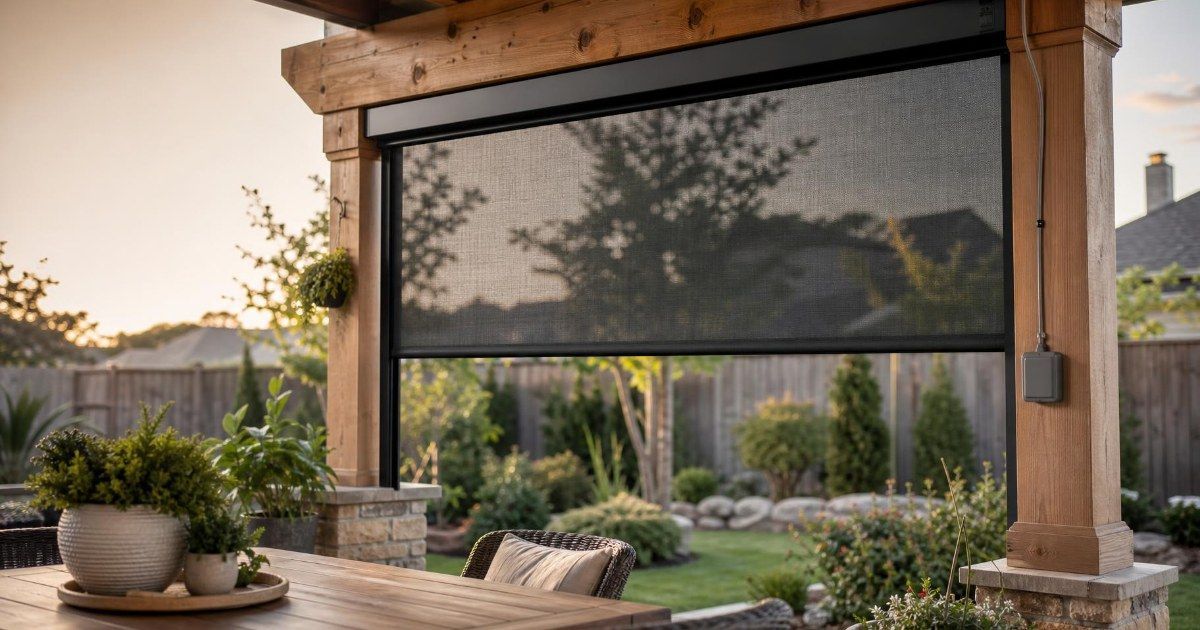
A side-track system typically costs more than an open-roll configuration because it adds guided retention, more hardware, and a cleaner perimeter seal. In practical terms, tracks help control fabric movement, improve edge stability, and create a more finished look. If your goal is to better manage bugs, glare, and wind movement at the patio edge, a track system often earns its keep.
That said, not every opening needs tracks. Some covered patios can use a simpler setup and still perform well. Others, especially wider openings or more exposed elevations, benefit from the added structure. The difference in prices is not cosmetic fluff. Tracks add materials, labor, and engineering value, especially where Houston wind and storms are part of the design conversation.
Wind rating specification
Houston homeowners miss this one all the time. A shade that looks similar online can be priced very differently depending on what wind performance it is designed to meet. Texas operates under the 2021 IBC with Texas amendments using ASCE 7-16 for wind load, which means local code and engineering expectations are part of real-world quoting. Source: Texas Department of Licensing and Regulation building code information.
That does not mean every backyard gets the same specification. Exposure, opening size, mounting condition, and product type all matter. But in Houston and along the Gulf Coast, wind is not a side note. It is a line item. If your system includes heavier-duty components, retention details, or wind sensors to help protect the shade during changing weather, that can materially increase the quote. For broader context on coastal performance, Shade Doctor’s article on high-wind shade systems explains why two systems with similar dimensions can have very different engineering behind them.
Installation complexity
Installation complexity is where quotes stop behaving like catalog math. A straightforward install on a new covered patio with square posts, accessible power, and clean mounting surfaces is usually more efficient. A retrofit with uneven masonry, hidden utilities, old trim, or no proper beam for attachment is slower and more expensive.
This is especially relevant in Houston because the housing stock is mixed. One homeowner in Bridgeland may have a new-construction covered patio designed with future screens in mind. Another in Montrose may have an older rear porch that was modified in stages over 30 years. Same opening width on paper, different installation in the field. Most installations price out closer to the lower end only when structure, access, and electrical conditions are favorable.
Cost by Opening Size
The table below gives estimate ranges for typical Houston residential openings. These are not fixed prices. They are planning numbers meant to help you self-qualify before a site visit. Final pricing follows a site measure, product specification, and review of the mounting structure.
In other words, use this as a map, not a signed contract. It should help you narrow your budget and understand where your project likely lands before precise measurements are taken.
| Opening Size Band | Typical Houston Estimate Range | Common Use Case | | --- | --- | --- | | Up to 8' wide x 8' drop | $4,500 to $6,500 | Small patio side opening, balcony, or narrow porch bay | | 9' to 12' wide x 8' to 10' drop | $5,500 to $8,000 | Standard rear patio opening on many suburban homes | | 13' to 16' wide x 8' to 10' drop | $7,000 to $10,500 | Larger covered patio span with stronger hardware needs | | 17' to 20' wide x 10' to 12' drop | $9,000 to $13,500 | Wide entertaining space, outdoor kitchen edge, pool patio | | 21' to 24' wide x 10' to 12' drop | $11,500 to $16,500 | Multi-bay or extra-wide covered patio opening | | 25'+ wide or specialty tall openings | $15,000 to $18,000+ | Large custom outdoor spaces, engineered openings, premium controls |
These ranges assume residential-grade motorized shades with quality outdoor fabric and professional installation in Houston, TX. They can move upward if you add a premium motor, advanced automation, side tracks, upgraded fabric grade, recessed housing, or structural buildout. They can also shift if your patio needs electrical work or custom trim integration.
If you are comparing quotes, make sure the systems are actually comparable. One proposal may include a stronger motor, a better warranty, or more robust tracks. Another may look cheaper because it excludes electrical work, omits sensors, or assumes easier installation conditions than the site really allows. Shade Doctor’s overview of how custom outdoor shades are measured and designed is a good reference point for understanding why site measure matters so much before final numbers are locked in.
Houston Cost Factors Homeowners Miss
By the time a homeowner starts pricing motorized screens or outdoor shades, they usually understand the obvious factors. They know bigger costs more. They know motors cost more than manual operation. What they often miss are the Houston-specific friction points that do not show up until the quote, permit, or scheduling stage.
These missed factors are the reason one family gets installed in a few weeks while another spends a month untangling approvals and structure questions. If you want a realistic budget and timeline, these are the details worth sorting out early.
HOA architectural review can slow the buying timeline
In Houston-area master-planned communities, HOA review is often part of the real project timeline. That does not always increase the equipment price directly, but it can affect scheduling, proposal revisions, and how quickly materials can be released. Community Associations Institute estimated that 5.6 million Texans lived in a community association as of 2018, so this is not a niche issue. Texas Property Code Chapter 209 also gives legal context for HOA architectural review authority in many residential communities.
If you live in Cinco Ranch, Cross Creek Ranch, Riverstone, Telfair, Bridgeland, Sienna, Woodforest, or Shadow Creek Ranch, it is smart to assume some level of architectural review until you confirm otherwise. Some associations care about housing color, exposed hood dimensions, side channels, or whether the system is visible from a street or trail. A delay here does not change the shade itself, but it absolutely changes your path to installation and can influence whether a custom design needs to be revised.
Retrofit complexity on older Houston housing stock
Retrofits in neighborhoods like the Heights, Montrose, Bellaire, and parts of central Houston often cost more than homeowners expect. Older homes can have out-of-plumb framing, mixed-material surfaces, patched electrical, and patio additions that were built in phases. That means more time validating the mounting surface, more custom trim work, and more caution around how the system interfaces with the structure.
On paper, an older home may have a smaller patio than a newer build in Katy or Cypress. In the field, it can still cost more to install. This is one of the biggest reasons neighbors get different prices. Retrofits are where easy installation goes to die. They are also where experienced design and field measurement matter most, because the system has to be tailored to what the house actually is, not what the listing photos suggest.
Structural buildout when a patio lacks a usable beam
Some patios simply are not ready for a motorized shade system without additional structure. If there is no suitable beam, header, or mounting surface, the project may need aluminum or steel buildout before the shade can be installed correctly. This is common on slab patios with roof extensions that were never designed to carry a retractable screen load.
That added structure can move a project from “screen pricing” into “screen plus carpentry or metalwork pricing.” Homeowners are often surprised by this because they are shopping for shade, not framing. But the system has to attach to something reliable. If your patio is more open-air and you are still deciding between enclosure strategies, Shade Doctor’s motorized patio shade systems page helps clarify where screens fit compared with other approaches to creating usable outdoor spaces.
Where Motorized Shades Save Money in a Houston Summer
Motorized shades can reduce solar heat gain on the patio and on adjacent glazing, which matters in a city where heat hangs on well after sunset. The value is usually less about a neat spreadsheet number and more about comfort, use, and load reduction around the home’s perimeter. We are not assigning a dollar savings figure here because that depends on orientation, glass area, fabric openness, and how the home is used.
Still, the mechanism is straightforward. A shade intercepts part of the sun before it reaches the patio surface, doors, and windows. That can reduce glare, improve comfort in nearby rooms, and make the transition space outside your home more usable during Houston’s hotter months. If your family avoids the patio every afternoon from June through September, that lost use is real even if it does not show up as a single line item on the utility bill.
This is especially true for west-facing patios and large sliding doors. In those conditions, outdoor shades can act like a wearable hat for the house. They do not change the weather, but they can block a meaningful share of the direct punishment from sun and uv rays before those elements hit the glass and concrete. That can help protect finishes, soften glare, and create a cooler-feeling zone for dining or lounging.
For homeowners also thinking about comfort beyond solar control, screened systems can add another practical layer by helping reduce flying pests during the months when bugs are most active. Shade Doctor’s article on how patio shades help with bugs covers that benefit in more detail, and it is often part of the value equation in Houston where evening patio use collides with mosquitoes.
Motorized Versus Manual: The Actual Price Gap
Manual shades are cheaper up front. In Houston, the actual price gap for a comparable opening is often substantial enough to matter, but not always so large that it changes the buying decision once homeowners think through daily use. A manual system may save money on the front end, especially for smaller openings or simpler patios. But once widths and drops get larger, the convenience gap becomes hard to ignore.
That is because a big patio shade is not like flicking a lamp switch. It is a large moving system exposed to sun, wind, and weather. With motorized shades, the control is cleaner, movement is more consistent, and the system is easier to use multiple times a day. If your goal is to lower screens at lunch, raise them for airflow later, and drop them again in the evening, motorization often changes whether the shade gets used regularly or becomes something you mean to adjust but rarely do.
In practical Houston terms, homeowners usually pay extra for the motor, controls, automation options, and related setup. The premium can be modest on some openings and more noticeable on larger or smarter systems. But the real comparison is not just purchase price. It is whether the patio becomes easy enough to manage that the shade actually improves your year round routine.
That is also why many buyers choose smart features once they are already investing in a custom system. Remote access, wall controls, pre programmed schedules, and smart home integration can make sense on a patio that is used for dinner, pool supervision, or outdoor entertaining. In some homes, a motorized screen tied to a smart home routine works almost like climate punctuation: lower in late afternoon, rise after sunset, adjust when weather shifts. If you are budgeting carefully, ask which smart features matter to you and which are nice but unnecessary.
How to Get an Accurate Houston Quote
The fastest way to get from broad estimate to useful number is to come prepared. A good consultation should narrow the range, not just repeat that “it depends.” The more accurate the information you bring, the more quickly a design team can determine if your project is straightforward, engineered, or likely to need structural work.
Before requesting pricing, gather the details below. This helps a dealer or installer distinguish between a standard-size opening and a more custom condition, and it can prevent the usual quote drift that happens when key information shows up late.
First, bring rough measurements for each opening. They do not need to be final, but they should be honest. Width and drop are the core pricing inputs. Second, note the patio orientation. A west-facing opening in Houston often drives different fabric recommendations than a north-facing one because the sun angle and heat load are not the same.
Third, know your HOA status. If you are in Katy, Cypress, Sugar Land, Pearland, Missouri City, or another master-planned area, find out whether architectural review is required. Fourth, take clear photos of the existing structure. Include the beam or header area, side mounting surfaces, ceiling condition, nearby doors and windows, and where power might be available. Those photos often reveal whether the installation is simple or whether hidden costs are likely.
Fifth, mention any preferences for automation. If you want a remote, wall switch, wind sensors, app control, or compatibility with a smart home platform, say so early. Those decisions shape the quote. Sixth, ask about current promotions if your project timing is flexible. Shade Doctor occasionally posts seasonal shade specials, and that can help if your budget is close to the edge of the range.
When you are ready to move from estimate to design, the best next step is a formal consultation with site measure and product specification. Shade Doctor’s consultation scheduling page is where that process starts, and it is the stage where rough online numbers become a real project scope with tailored pricing, warranty details, and installation timing.
FAQ About Motorized Patio Shade Cost in Houston
These are the questions Houston homeowners ask most often when they are close to buying and trying to understand whether the project fits their patio, budget, and expectations. The short answers below are localized to Houston conditions rather than generic national averages.
If you are comparing multiple quotes, use these answers as a filter. The right question is not only “what does it cost,” but also “what exactly is included for that price in Houston weather and housing conditions?”
How much do motorized shades typically cost?
In Houston, a typical residential motorized shade project often starts around $4,500 for a smaller opening and can run into the mid five figures for larger multi-opening patios with side tracks, upgraded controls, and more complex installation. For many homeowners, the sweet spot is in the $6,000 to $12,000 range, but exact prices depend on width, drop, fabric, wind specification, and structure.
That range is broader than what some national articles suggest because Houston conditions tend to push buyers toward stronger outdoor shades, deeper shade fabrics, and more weather-conscious design choices. A local site measure is what turns that estimate into a reliable number.
Are motorized shades worth the money?
For many Houston homeowners, yes. The value usually comes from making the patio more usable during long hot stretches, reducing glare near adjacent windows, improving comfort, and making the system easy enough to operate that it gets used consistently. If you entertain outside, supervise kids in the backyard, or want better bug control in the evenings, the convenience can be significant.
They make the most sense when the patio is already part of your routine or when the sun and heat are actively limiting how you use the space. If the patio is rarely used and has minimal exposure, the return may feel less compelling.
How much extra do you pay for motorised blinds?
In Houston patio applications, the premium for motorization depends on the opening size and control package, but homeowners should expect to pay meaningfully more than a manual setup for the added motor, automation hardware, and programming. On some projects the gap is moderate. On larger shades, the convenience and control system become a more visible part of the total.
The key is to compare apples to apples. A quote with motorization may also include better controls, cleaner movement, and options like wind sensors or smart home integration that a manual system cannot match.
How much should motorized blinds cost per window?
That question is more useful for interior window treatments than for Houston patio shades, because exterior systems are priced by opening conditions, structure, and engineering rather than by a simple per-window formula. If your patio has multiple bays, each opening may need different hardware or mounting details even when they look similar from the yard.
For planning purposes, think in terms of each patio opening as its own project component. A narrow side bay may price very differently from a wide central opening with doors, tracks, and higher wind exposure.
Are motorized shades expensive?
They are a premium exterior product, so yes, they are more expensive than simple manual screens or basic interior blinds. But in Houston, where patios function as real living space for much of the year, many homeowners see them as a comfort and usability upgrade rather than a decorative add-on.
The best way to judge cost is to compare it with how much you use the patio now and how much more often you would use it with better shade, control, and weather resilience. For buyers already planning outdoor improvements, motorized shades often fit the budget more logically than people expect once they understand the local pricing drivers.