Do I Need HOA Approval for a Pergola in Houston? How Texas Rules Work and How to Get a Yes
If your home sits inside an HOA or a deed-restricted subdivision, a permanent pergola almost always goes through architectural review before anyone breaks ground. So, do I need HOA approval for a pergola in Houston? In most neighborhoods, yes. Texas law gives pergolas no special protection from that review, which means your community's recorded rules decide the question.
Planning for approval from the start keeps a pergola project on schedule and on budget. This guide covers why Houston leans on deed restrictions, what the Texas Property Code says, what an architectural committee looks at, who reviews plans in a master-planned community, how to build an application, what to do after a denial and what happens when a pergola goes up without a green light.
Why Houston Homeowners Run Into Deed Restrictions More Than Most
Houston has no zoning. In most cities, zoning decides how tall a structure can be, how close it can sit to a property line and what it can be used for. In Houston, recorded deed restrictions and HOA declarations do that job, and they reach into the backyard. That is why deed restrictions on patio structures in Houston matter as much as anything the city requires.
A deed restriction is a rule attached to the land and recorded in the county's property records. A declaration, often called the CC&Rs, is the master document for a subdivision. It sets the rules and creates the association that runs them. Texas has an estimated 22,900 community associations covering about 6.2 million residents, the third most in the country, and newer neighborhoods across Harris, Fort Bend and Montgomery counties are commonly part of one.
An HOA usually has mandatory membership and collects assessments under the declaration. A civic club is often a voluntary group in an older neighborhood that works to uphold the same kind of recorded restrictions. Some neighborhoods have both, and some older ones have restrictions with no active group behind them. In each case the restrictions themselves still apply to the lot.
The City of Houston plays a smaller part. Its authority comes from Chapter 212 of the Texas Local Government Code and City Code Sections 10-551 through 10-555, and it covers certain restriction types only. Architectural approval stays between the owner and the association.
Can My HOA Stop Me Building a Pergola? What the Texas Property Code Says
Yes, an HOA can deny a pergola or approve it with conditions. Texas does stop associations from banning a short list of items outright, although they may still regulate them. The list includes flags, seasonal political signs, religious displays, rain barrels, drought-resistant landscaping, security cameras, perimeter fencing, solar energy devices, standby generators, pool enclosures and certain shingles. The Texas State Law Library's guide to restrictive covenants covers each one. Pergolas, patio covers and gazebos are not on it.
That gap matters because of how Texas courts view an association's choices. Under Texas Property Code Section 202.004, an association's use of discretionary authority over a restrictive covenant is presumed reasonable unless a court finds by a preponderance of the evidence that it was arbitrary, capricious or discriminatory. A committee that turns down a pergola because it is too tall for the lot, or too close to the fence, is using the kind of discretion the law protects.
The Texas Property Code on architectural review also explains why paperwork carries so much weight. A dedicatory instrument, which is the legal term for declarations, bylaws and design guidelines, has no effect until it is filed in the real property records of the county where the property sits. The recorded version is the one that counts. A rule mentioned in a newsletter or a neighbor's memory carries no weight, and a rule in a recorded amendment does.
In practice, that sets your first move. Read the recorded declaration and any recorded design guidelines for your section of the neighborhood before you choose a pergola.
What the Architectural Committee Looks at on a Pergola
HOA architectural review in Texas follows the community's own design guidelines, and most committees weigh the same handful of factors. Height and footprint come first, since a taller or wider structure changes how the lot looks to everyone around it. Setbacks follow, meaning how far the pergola stays from the side and rear property lines and from any easements.
Placement matters too. A backyard pergola behind a fence draws less attention than a structure visible from the street, and many guidelines treat front-yard and side-yard locations more strictly. Committees also ask whether the pergola is attached to the house or freestanding, because an attached structure ties into the roofline and the framing of the home.
Roof type shapes the review. Open rafters, a louvered roof and a solid cover each handle sun, rain and drainage differently, and guidelines often address them separately. Reviewers look at where water will run, since runoff cannot spill onto a neighboring lot. Materials and color come last. Committees want a structure that coordinates with the house trim, siding and roof, and powder-coated aluminum in a neutral finish usually fits easily alongside brick and stone.
Homeowners often ask whether a small or freestanding pergola needs review at all. Some declarations carve out small or temporary structures, and others cover anything permanent in the yard, freestanding pergolas included. No general size rule settles it. The answer sits in the wording of your declaration, so find the sections on improvements, accessory structures and outbuildings and read how they define a structure.
Master-Planned Communities: Who Is Actually Reviewing Your Plans
Master planned community pergola rules often come from a reviewer you might not expect. In a newer community, the developer, called the declarant in the legal documents, frequently still controls the architectural committee during what the law calls a development period. That is a period stated in the declaration when the developer keeps the right to guide construction and marketing of the subdivision.
The timing carries legal weight. The written-denial and hearing rights described in the next section do not apply during a development period or while the declarant controls appointments to the architectural review authority or holds a veto over it. During that time, the developer's decision is the decision.
To find out who is reviewing your plans, read the architectural section of the declaration, which names the reviewing body and says who appoints it. The association's website and its management company can confirm whether the developer or a resident board holds the seat today.
Control changes hands when the developer turns the association over to the owners. After that, a committee appointed by the resident board reviews applications, and the appeal rights apply. Since September 2025, current board members, their spouses and people in a board member's household may not be appointed or elected to the architectural review authority in most cases, and the association must give at least 10 days' notice when it asks for volunteers. That separation gives homeowners a reviewer who is not sitting on the board that hears the appeal.
How to Get Your Pergola Approved, Step by Step
Start with the recorded documents. Search the Harris County Clerk's Real Property records for your subdivision, or check the association's website. Associations with at least 60 lots, and any association with a management company, must post their current recorded documents online for members. Read the sections on improvements, accessory structures and architectural review, and note the design guidelines and any application form.
Next, assemble the application. Committees usually ask for a site plan that shows the pergola's location and setbacks from each property line, a dimensioned drawing or elevation, the product specification, the materials and colors, the mounting or footing method and photos of the spot where it will go. Engineering drawings come into the picture only where your guidelines or the city call for them.
Submit everything in one package. A complete packet gives the committee nothing to send back for more information, and each round of questions adds days. Review times vary widely across the Houston area depending on the municipality and the scope of the project, so the approval period belongs in the overall pergola installation timeline from the beginning. A professional installer can help guide you through that process.
Keep the written approval once it arrives, along with any conditions attached to it. Then build exactly what was approved. A change in size, color or placement after approval can turn a finished project into a violation, so send any revision to the committee before the crew changes the plan.
What to Do If Your HOA Says No
In associations of more than 40 lots, a denial has to meet clear requirements. It must be in writing and delivered by certified mail, hand delivery or electronic delivery. It must describe the basis for the denial in reasonable detail, list any changes that would earn approval and tell you that you may request a board hearing within 30 days. These protections apply once the developer's control has ended, as covered above.
If you request the hearing, the board must hold it within 30 days of your request and give at least 10 days' notice. Either side may ask for one postponement of up to 10 days, and either side may make an audio recording. After hearing from you, the board may affirm, modify or reverse the committee's decision.
Most homeowners get further by revising the plan than by arguing the denial. Work through the stated reason point by point. If the objection was height, lower the structure or move it toward the center of the lot. If it was visibility, add distance from the street or a fence line that screens it.
Walk your street and photograph similar structures the association has already approved. Those photos show the board what the community accepts. Then resubmit a complete packet that answers every reason in the denial letter and includes the revised drawing, specification and site plan.
Building Without Approval, and Whether Neighbors Can Complain
When a pergola goes up without approval, the association usually starts with a written notice and a chance to correct the problem. Texas law does not give an association the power to fine on its own. Fine authority has to come from the governing documents, and an association that fines must adopt and publish an enforcement policy. Before fining, it sends a notice that describes the violation, states the proposed fine, explains your right to request a hearing within 30 days and, for curable violations, gives a reasonable period to cure. Building something that does not match approved plans is listed as a curable violation.
If the problem continues, a court can assess civil damages of up to $200 for each day of a violation, and a court can order a structure removed.
Neighbors enter the picture because can neighbors complain about a pergola is a fair question, and the answer is yes. In Texas, any owner in a subdivision can enforce its deed restrictions. Inside Houston city limits, residents can also contact the City about the restriction types it enforces. Under Ordinance 10-553, the City enforces restrictions on use, building setbacks, lot size, the size, type and number of structures on a lot, structure orientation and fences that need a building permit. Complainants may stay anonymous, and most violations end with a warning letter.
The same City presentation notes that the City does not enforce plan submission requirements or architectural controls. Approval of your pergola's design remains a matter between you and your association, while a setback or structure-size complaint can reach the City.
Planning a Pergola That Passes Review
HOA approval and a city permit are separate approvals, and one does not replace the other. The association reviews your plan against its recorded restrictions, and permit requirements come from the city or county. Shade Doctor's site notes that permit needs depend on the region.
The factors committees weigh line up with the features of Shade Doctor's modular pergolas. They are freestanding, with a manual louver system that needs no power source, powder-coated aluminum construction, an integrated gutter system for drainage and optional privacy walls. They come in 10x10 and 12x12 sections that combine for larger coverage, so the footprint can be sized to your setbacks. Homeowners who prefer remote operation can look at motorized pergolas with adjustable louvers.
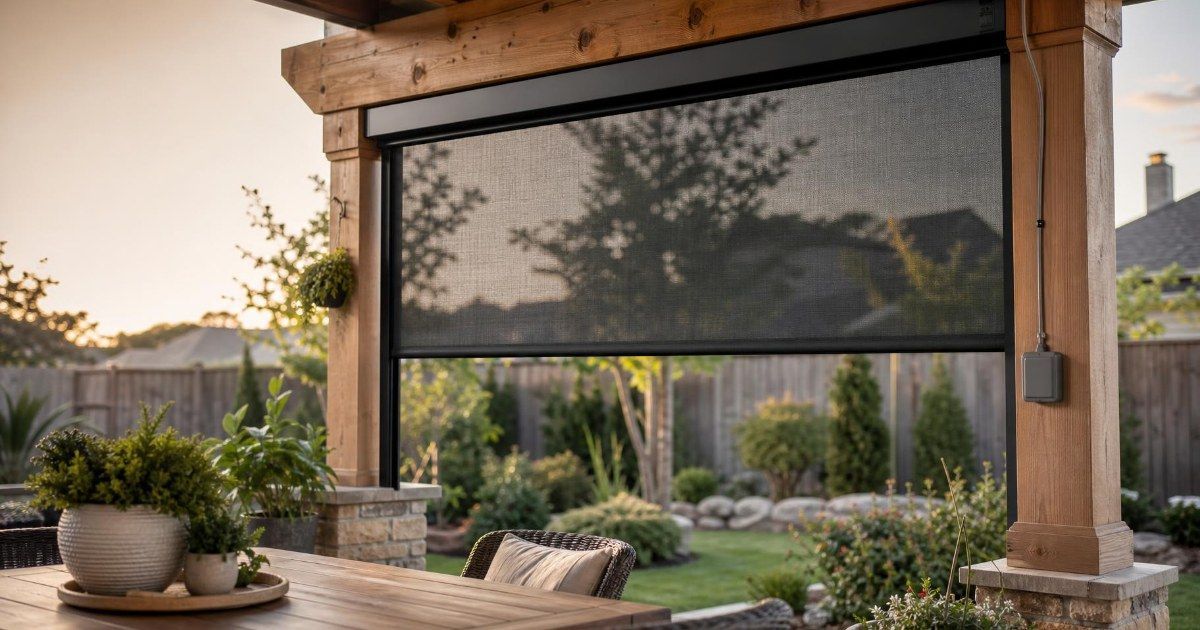
For Houston homeowners, Shade Doctor's page on shade options for Houston patios adds that a retractable shade that rolls away when not in use generally moves through review more easily than a permanent structure, and that committees typically want a dimensioned drawing, product specification, fabric color and mounting method.
When you are ready to plan,
Schedule a Consultation and bring your declaration and design guidelines along.