How to Anchor a Pergola Without Drilling: What Holds and What Doesn't
A pergola can be held down without drilling. Ballast works for a light, freestanding frame in a sheltered spot. Screw-in augers work in open soil. Straps can tie the frame to something that is already fixed. Each of these gives the frame a different kind of grip, and an anchored footing that ties the posts into the ground grips in a way none of them can match.
Most people who search for how to anchor a pergola without drilling have a good reason. They rent the patio, or the surface is decorative pavers or tile, or the pergola is a seasonal or temporary setup. Each of those is a fair reason to leave the drill in the garage.
This post covers each method, what it actually resists and where it stops working, with notes for Houston-area patios along the way.
What a Pergola Anchor Actually Has to Resist
Wind gives a pergola three jobs to resist. Uplift is wind lifting the frame. Sliding is wind pushing the whole frame across the ground. Racking is wind pushing the top sideways until the frame leans out of square. Every set of pergola anchors has to answer all three.
An open frame looks like it lets wind pass through. Louvers, slats, privacy screens, climbing plants and hanging panels each give the wind a surface to push on, and the frame then catches wind like a sail. The load travels down the posts into whatever holds them, which is why uplift and lateral load are the two forces installers design around.
Anchors come in two kinds. Weight resists by mass: a heavy base takes more force to lift or slide. A tie anchor joins the post to the ground or to a fixed structure, so the post cannot leave without taking that ground or structure with it.
Weight helps most when it is fastened to the post. Nothing joins a planter sitting a foot from a leg to that leg, so the planter adds nothing to the frame.
No-Drill Pergola Anchors Compared
Six no-drill options cover most patios and yards. Each one gets a short how-to and the point where it lets go.
Weighted Bases and Planters
Planters filled with sand, gravel or concrete, and purpose-built post weights, give each leg a heavy foot. A cubic foot of concrete weighs about 145 pounds, so a filled planter adds real mass. Set one at the foot of each post, fill it, and fasten the post base to it with the bracket the weight was made for. Then push on each side of the frame to see whether the weight and the post move as one. Heavy furniture placed near a leg is only furniture, since nothing ties it to the post.
Sandbags and Water Weights
Sandbags and water weights are easy to move, fill and empty. Fill each one, set it at the foot of a post and strap it to the post so it cannot shift. Water weighs 8.34 pounds per gallon, so a water weight's ballast is its capacity in gallons times 8.34. Sun and weather break down the fabric and seams, which makes these a fit for temporary or seasonal setups. Check each one for leaks, splits and slumping before every storm.
Concrete Blocks With Brackets or Straps
Concrete blocks go under or beside each post. Set the block level, then join it to the post with a bracket or a steel cable so the block and the post move as one. A block that only sits beside a post gets left behind when the frame lifts. Use the same number of blocks at every leg, and tighten the ties after the first week, since a new setup settles.
Ground Augers and Screw Anchors
Ground augers and screw anchors twist into soil. Mark each post position, turn the anchor in by hand with a steel bar until it reaches its full depth, then join it to the post with a strap or bracket. Soil is the only surface they grip, so a slab, a patio or compacted gravel gives them nothing to bite. The next section covers how soil type changes what they hold.
Strapping to an Existing Structure
Ratchet straps and guy lines can run from the frame to a deck post, the framing of the house or another fixed point. Angle each line away from the pergola, pull it snug and check it after wind. Fence panels often give way before the pergola does, so pick the sturdiest anchor point available. Strapping is extra support, and a pergola that stays for years needs a base that holds it down on its own.
Adhesive-Set Bases
Construction adhesive or adhesive pads bond a base plate to concrete or tile. Clean and dry the surface, apply the adhesive across the plate, press it down and give it the full cure time on the label before the frame goes up. Wind twisting the frame works at the bond a little with each storm, and the bond can break over time. This method suits a small, light frame on a surface that has to stay undrilled.
How to Anchor a Pergola to the Ground Without Concrete
Lawns and open soil are where augers and helical screw anchors do their best work. The steps for how to anchor a pergola to the ground this way are short. Sink each anchor to its full depth, set one at every post, and join each anchor to its post with a strap or bracket. An anchor that stops halfway down holds a fraction of what it was made to hold.
How well an anchor holds depends on the soil around it. Federal standards for ground anchors, written for manufactured homes, rate each anchor by soil class and require installation to full depth. Loose, sandy or recently filled soil gives an anchor less to grip, and a freshly graded yard is often that kind of ground.
Clay brings its own twist in the Houston area. Expansive clays swell when they get wet and shrink when they dry, opening deep, wide cracks, and several of these soils are found mostly in Texas. That seasonal movement can work an anchor loose over time. Installers see the same pattern with shallow footings in clay. Check each anchor at the change of season and take up the slack in each strap.
Tent stakes and guy ropes are made for canopies. A framed pergola puts far more load on each leg than a canopy does, so stakes of that size give it too little grip.
How to Anchor a Pergola to Pavers Without Drilling
Pavers rest loose on a bed of sand and gravel. Anything fastened to a single paver lifts with that paver, so a base bonded to one stone ties the frame to a stone that can rise. Every no-drill answer to how to anchor a pergola to pavers works around that fact.
The first option is a ballast base that rests across several pavers. A wide base plate or a long planter spans more than one stone, so lifting the post means lifting every paver under the base at once. The weight and the width do the holding.
The second option is lifting one paver at each post and sinking an auger through the sand and gravel into the soil below. The auger has to be long enough to pass the base and reach firm ground. You then cut or reset the paver around the post. This option gives the grip of the ground anchors described above, and it changes the patio surface at every post, so it suits an owner who can reset pavers cleanly.
The third option is an interlocking paver base, where the post feet sit in a frame of locking pavers that holds by weight and friction. The stones press against one another and resist sliding as a group. Pavers at the border of a patio can shift outward, so a base set toward the middle of the patio has more restraint than one set at the edge.
How Much Weight Does a Pergola Need?
No single number answers this one. Four things set the amount. Frame size and material decide how much surface the wind can push on. The roof type matters because a solid or louvered roof catches far more than open rafters. Accessories such as screens, curtains, panels and climbing plants add area. Exposure decides how hard the wind arrives, and a spot open on every side asks for more than a courtyard sheltered by walls.
Published rules of thumb disagree with one another, since each is written for a different frame and a different climate. A figure meant for a small gazebo in a mild region says little about an aluminum pergola on the Gulf Coast. Work from the frame in front of you.
Split the weight evenly across every leg and join each weight to its post. Even weights keep any one corner from becoming the weak one. Once the frame is set up, push on each side of it at roof height with steady force. A frame that shifts, rocks or lifts at a corner needs more weight, better ties or a different method.
Straps, ties and weights loosen over time, so check them after storms and at the change of season. Look for frayed webbing, rust on cable clamps, leaking water weights and gaps in the soil around augers.
When No-Drill Stops Being Enough in Houston
Ballast is the wrong choice for a permanent install, a larger or taller frame, a solid or louvered roof, and an open lot with nothing to block the wind. Gulf Coast storms add to that list. The National Weather Service counts gusts over 58 mph as severe thunderstorm strength, and on May 16, 2024 a derecho sent a swath of 75+ mph winds across southeast Texas. In east Harris County communities such as La Porte and Seabrook, the state's windstorm program uses a 120 mph design gust.
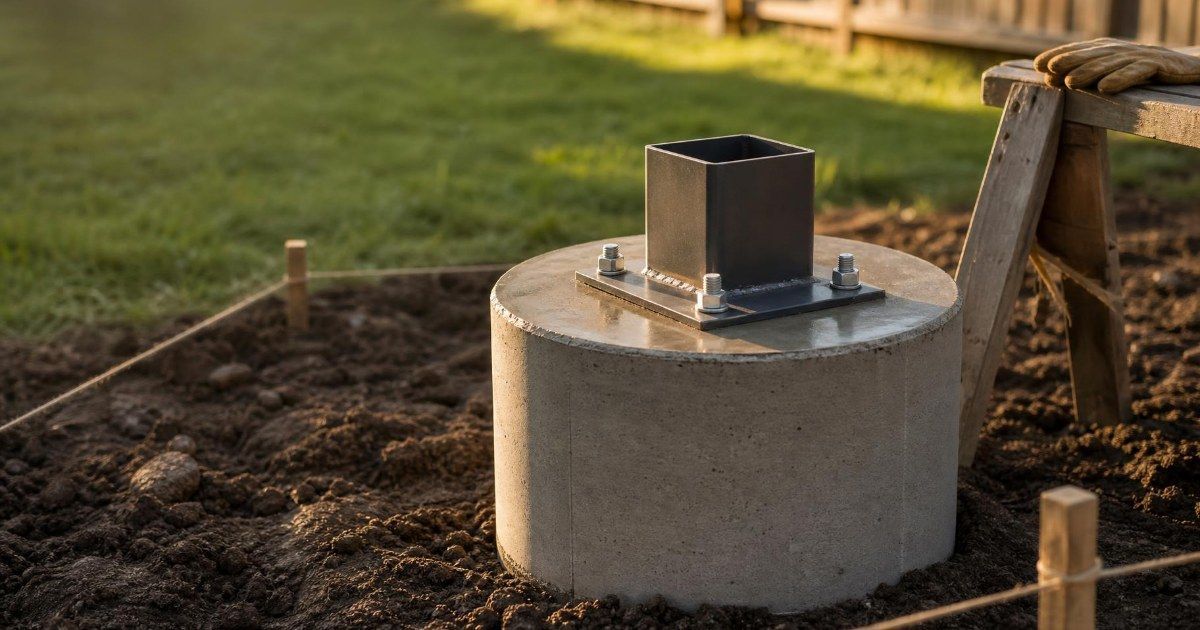
Weighted corners resist casual tipping. Anchored footings or piers resist uplift, and where wind is significant that difference decides whether the frame stays put. Shade Doctor's guide to how deep pergola posts should be buried takes the same position. It also covers the fixed options, anchoring into a slab or pouring piers, which are a separate job from anything in this post.
For a permanent, louvered structure, Shade Doctor builds motorized pergolas with powder-coated aluminum frames, motorized louvers and integrated gutters. Closed louvers form a roof, and a roof is the kind of surface this section is about.
Choosing the Right Method for Your Pergola
Start with the surface. Soil takes augers tied to every post. Pavers take ballast spread across several stones, or an auger through a reset paver. A slab takes ballast bases, and a small light frame can take adhesive-set bases.
Then weigh how long the pergola will stay. Sandbags and water weights suit a season, while blocks and planters tied to the posts suit a few years in a sheltered yard. Finally, look at how exposed the spot is.
For a permanent pergola, Shade Doctor's process begins with a consultation, moves to a custom design proposal and ends with professional installation. You can schedule a free consultation to start.